
A drop in funding forced us to make a hard decision: reduce staff. Every nonprofit leader knows this moment: the budget no longer supports the team you've built, and you have to make cuts you didn't want to make.
What I didn't fully anticipate was what would leave the organization with each person.
We started losing more than headcount. We started losing institutional knowledge, the kind that never made it onto paper because it lived entirely in someone's head. A scholarship process. A vendor relationship. A reporting workflow. Each one ran smoothly for years, right up until the person who knew how to run it was gone. Then the process didn't just slow down. In some cases, it disappeared, and we were reconstructing it from memory, scattered emails, and trial and error.
That was the moment I had to be honest with myself as a leader: we had built an organization that depended on individuals instead of systems. And dependency on individuals, no matter how talented or loyal, is not resilience; it's risk wearing the disguise of efficiency.
The Diagnosis
We sat down and discussed it at length. The conversation kept circling back to the same uncomfortable truth: we didn't have a documentation problem so much as a systems problem. We had built capacity in people without building capacity in the organization itself. Every workaround, every "ask so-and-so; they know how to do that," was a small admission that our institutional memory had a single point of failure and we had several of those points scattered across nearly every department.
So we began a comprehensive review of our Standard Operating Procedures. We built a master list organized by department, surfacing not just what existed informally but what had never been written down at all. We brought in AI tools — Claude.ai and ChatGPT — to help us draft a consistent SOP template and to flag gaps we hadn't thought to look for. That accelerated a process that would otherwise have taken months of manual mapping into something we could move on to in weeks.
The Leadership Lesson Hiding Inside the Project

Photo by Alexandr Podvalny on Unsplash
Here's what I learned about my own role in this, and it's the part most leaders skip past: identifying the problem is the easy part. Protecting the solution is the hard part.
SOPs are not a one-time project. They require periodic review and the discipline to create new ones as the organization evolves. But documentation work is rarely anyone's urgent priority; it's important, but it's never the fire burning loudest on a given day. Left to its own momentum, this kind of work gets quietly deprioritized by the next grant deadline, the next program crisis, or the next board request.
I had to become the person in the room asking, repeatedly and sometimes annoyingly, "Where are we on this?" Not because the team wasn't capable; they were, but because someone has to hold institutional capacity-building as a standing priority when nothing about it feels urgent. That's not a project management skill. That's a leadership posture. It's the discipline of protecting what matters from being crowded out by what's merely loud.
I've come to believe this is one of the most underrated functions of leadership in under-resourced organizations: not generating the vision, but defending the boring, unglamorous work that makes the vision survivable past the founder, past any one staff member, past the next funding cycle.
Why This Isn't Just an Operations Story
Consider something as specific as how we award scholarships to students in our programs. If that process exists informally, dependent on one staff member's judgment calls, undocumented criteria, and institutional habit rather than institutional standards, then the fairness of the outcome is only as consistent as that one person's good days and bad days. Formalizing the procedure doesn't just protect us operationally. It protects equity for the student on the other end of that decision, who has no idea any of this is happening and shouldn't have to.
This is the part that should unsettle every mission-driven leader: the absence of a system isn't neutral. It has a cost, and that cost is usually paid by the people we exist to serve, not by us.
The Real Outcome
What began as a response to a funding crisis became something more valuable than the crisis itself revealed: an organization that is less fragile, more consistent, and less dependent on any single person to function well, including me.
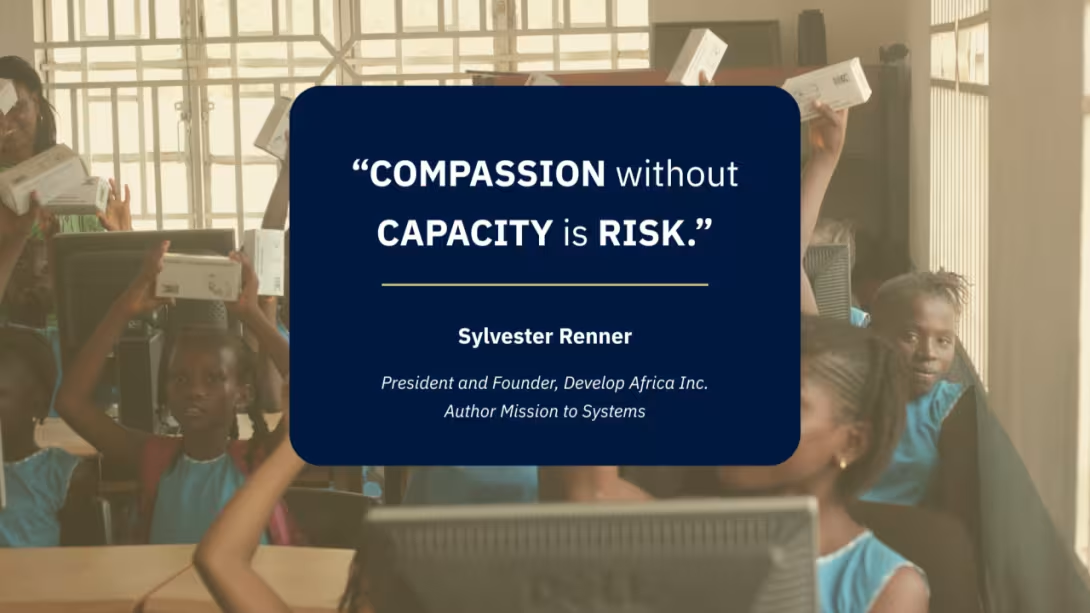
Compassion without capacity is a risk. Systems are how compassion survives contact with reality, year after year, staff transition after staff transition. Building those systems isn't a side project to the mission. It is the mission, expressed in a form that outlasts any one of us.
If your organization has never asked the question "What happens if this person leaves tomorrow?" ask it now, while you have the luxury of asking it on your own terms instead of theirs.
Sylvester Renner is Founder and President of Develop Africa Inc., a 501(c)(3) nonprofit focused on educational access and community resilience in Sierra Leone. He represented Develop Africa during the 2014-2015 Ebola response and is the author of Mission to Systems: A Governance Framework for Nonprofit Leaders.